
Spotsylvania Parole and Probation
Parole and probation both permit life in the community under rules, but their legal sources differ. A Spotsylvania County judge imposes probation. It may follow the active part of a sentence, accompany suspended time, or begin without a prison term. The Virginia Parole Board decides discretionary parole for the limited group that remains eligible. VADOC Community Corrections then supervises both probationers and parolees assigned to state supervision. Neither label should be inferred from a jail roster. Rappahannock Regional Jail is the adult local custody point, while Fredericksburg District 21 is the VADOC field office serving Spotsylvania County.
The distinction matters when reading a result. Someone listed at District 21 is in the community supervision system, not necessarily in a prison. Someone at an institution or regional jail remains in secure custody. Local Community Based Probation and Pretrial Services are separate RRJ programs and should not be relabeled as state parole. A parole grant also is not a physical release timestamp. It begins a plan and release process that can still involve record review, warrants, detainers, and conditions.
| Point | Parole | Probation |
|---|---|---|
| Authority | Virginia Parole Board for an eligible prison sentence | Sentencing court |
| When it applies | Conditional release before the maximum term | Instead of incarceration or after active time |
| Local state office | VADOC Fredericksburg District 21 | VADOC District 21 when state supervised |
| Best public clue | Board decision plus VADOC status | Court order plus VADOC status |
| How it ends | Parole discharge or other lawful termination | Court or agency discharge under the order |
- Parole
- Conditional community release from a parole-eligible sentence before its maximum end.
- Probation
- Court-ordered community supervision that may follow active time or replace it.
- Discharge
- The formal end of a supervision term, not merely removal from an online locator.
- Absconder
- An agency status for a supervisee alleged to have stopped reporting or left supervision, not a label created by public guesswork.
Check Spotsylvania Post-Release Supervision
The official VADOC Inmate and Supervisee Locator covers state institutions, local or regional jails under VADOC authority, Community Corrections Alternative Program placements, and people on probation or parole. That broad scope is useful, but it requires close reading. The strongest search uses the seven-digit DOC ID. A name search requires at least the first three letters of the first name and the full last name. Optional age, race, gender, and location filters should come later so an old or unexpected location does not hide the right record.
Use the result as a dated clue. VADOC says the locator updates daily and may contain inaccurate or outdated information. Match the DOC ID, name, age, and other identifying facts before acting on it. A District 21 or other community-supervision location points toward release from secure custody with supervision still active. An institution or jail means custody continues. If no result appears, do not turn absence into a discharge date. Fully discharged records may no longer be part of the public locator.
- Collect the full name, approximate age, seven-digit DOC ID if known, and the Spotsylvania court case number.
- Search the VADOC locator broadly, accept its disclaimer, and compare all displayed identifiers.
- Read the location and status literally. Separate a community district result from an institution or jail result.
- Check the court docket for probation terms, later violations, or an order ending probation.
- For parole, compare the result with the Board's monthly decision report, then ask District 21 for the correct contact route.
- When durable proof is needed, request the discharge order or letter from the court, VADOC, or Board.
The official VADOC locator view illustrates the search fields and the custody-versus-supervision boundary. See the Inmate and Supervisee Locator source before reviewing the captured interface.
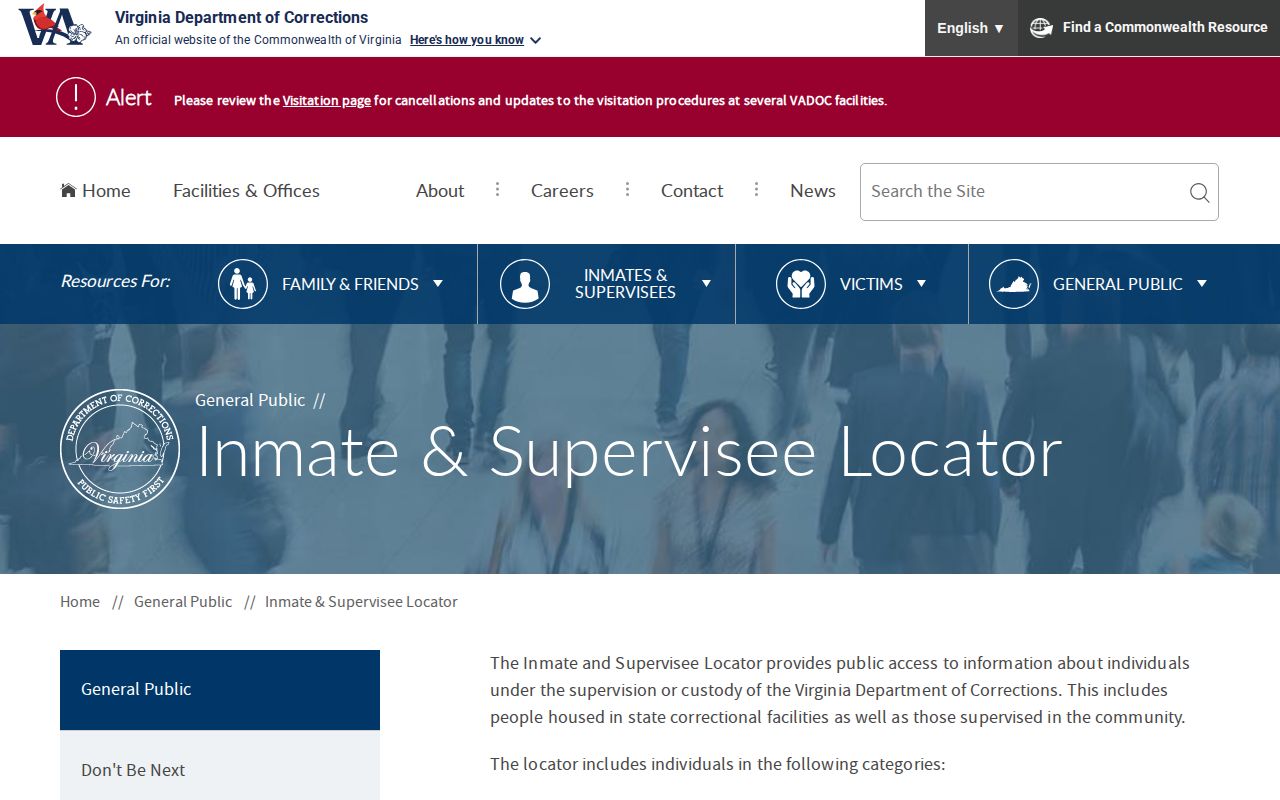
The displayed location and status must be preserved with the date checked because the public system changes as custody and supervision change.
For the broader release-record chain, the Spotsylvania County released-inmate search explains how RRJ, court, VADOC, and federal records answer different parts of the same inquiry.
Note: A community-supervision result supports release from secure custody, but it does not prove that all correctional control has ended.
Spotsylvania Probation District 21
Spotsylvania County state supervision is routed through VADOC Fredericksburg District 21. The official office listing serves Fredericksburg and Spotsylvania, Stafford, and King George counties. This regional assignment mirrors the area's correctional structure: RRJ is also a regional jail rather than a Spotsylvania-only facility. Calling the correct level prevents a local program from being mistaken for parole and prevents a state probation case from being sent to RRJ Community Corrections.
VADOC Fredericksburg District 21
5620 Southpoint Centre Boulevard, Suite 110
Fredericksburg, VA 22407
Phone: 540-710-2102
Service area: Spotsylvania, Stafford, King George, and Fredericksburg
District 21 can identify the right office path, but privacy and safety rules may limit person-specific details such as a reporting schedule. State supervision questions belong there. The Virginia Parole Board handles the discretionary decision, while a Spotsylvania court controls probation orders. For local pretrial or Community Based Probation, use RRJ instead.
The official directory can be filtered to the office that serves Spotsylvania County. Review the VADOC facilities and offices directory alongside the captured District 21 listing.
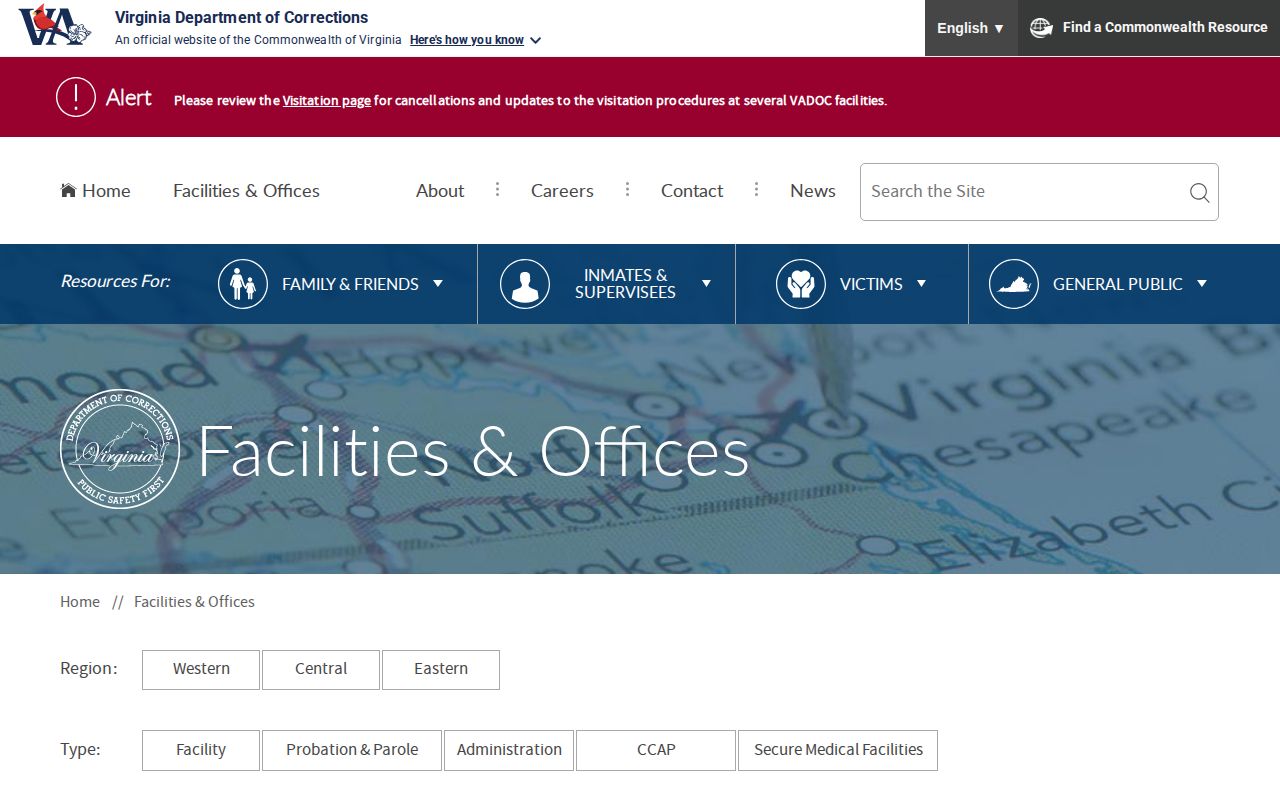
The regional service area shown there is why a Fredericksburg address can be the correct supervision contact for a Spotsylvania case.
Spotsylvania Release Program Landscape
RRJ operates a second, local supervision layer. Its named programs are Pretrial Services, Community Based Probation, Home Electronic Monitoring, Adult Drug Treatment Court, and Work Release. Each has a different legal posture. Pretrial supervision concerns a pending case, so the person has not completed a sentence merely because secure detention ended. Community Based Probation is a court-ordered post-sentence alternative. Home electronic monitoring and work release remain structured programs with rules and possible jail reporting.
Work release referrals come from participating local courts. RRJ describes the program for low-risk, nonviolent participants with fewer than 24 months and no pending court dates or charges, and participants return nightly. Electronic monitoring materials describe less than 12 months remaining, a stable and safe release plan, and a daily program charge. Those details help interpret status. They do not establish full discharge. RRJ publishes separate program numbers, and its pages show more than one number for Community Based Probation, so the current directory should be checked before calling.
RRJ also documents a local reentry path through its Community Corrections work. Spotsylvania grant material connects RRJ's Courage to Change program with FailSafe-ERA's Right Road Reentry Program. That handoff is a transition resource, not proof of parole, probation, or discharge. The governing record still comes from the court, VADOC, the Board, or RRJ program office that has authority over the person.
The RRJ Community Corrections page shows these alternatives in their local context.
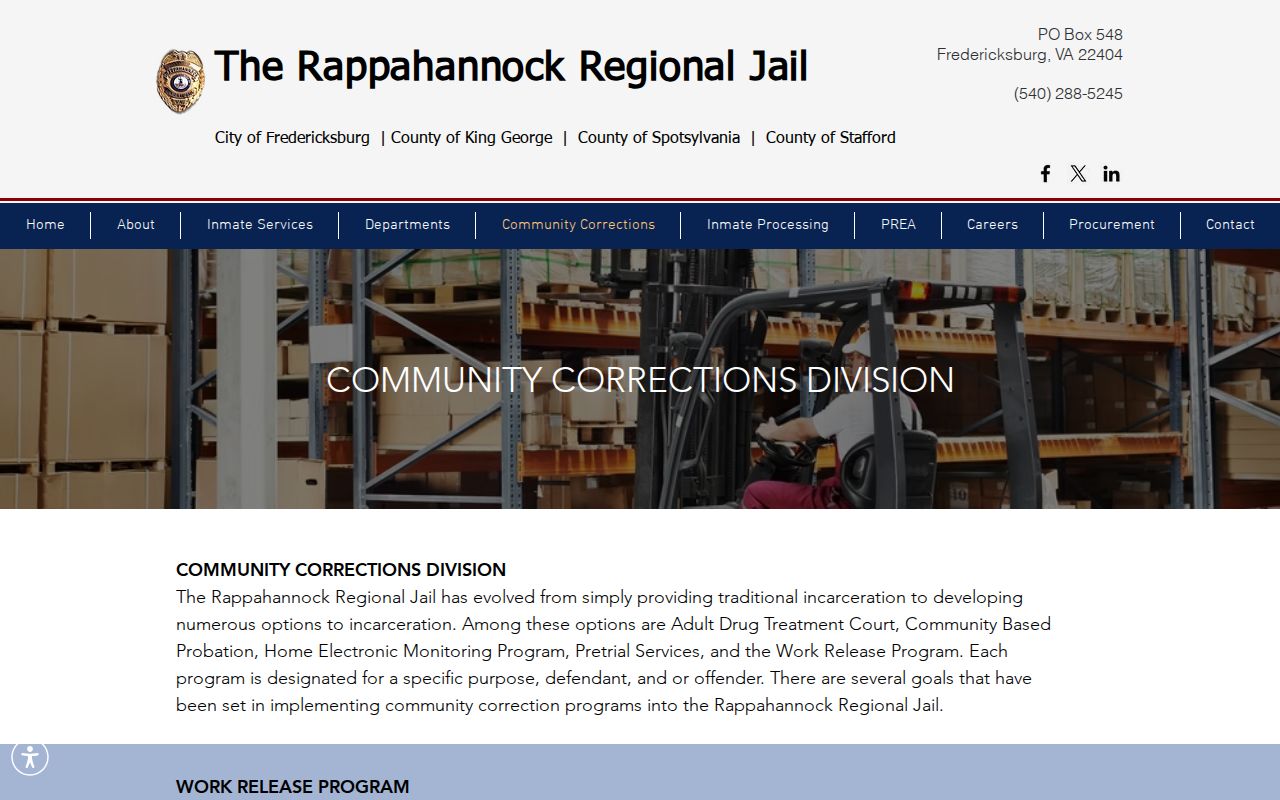
The program list makes clear why the phrase “on supervision” must be tied to a named agency and order.
Note: Work release and electronic monitoring can allow movement outside the jail while structured custody or program duties still remain.
Spotsylvania Parole Decision Records
The Virginia Parole Board publishes monthly parole decision reports and annual reports. These are the best official public source for a completed discretionary parole action. Virginia law requires reporting of prior-month actions with details that include the person, offense, jurisdiction, sentence information, decision, individualized reasons, and final vote information under the applicable timing rules. A grant means the release plan moves forward. A denial, deferral, or rescission does not authorize a present release.
The Board's Public Meetings page posts meeting dates, agendas, live access, and minutes. It is not a steady name-by-name hearing calendar. Since July 2024, the final deliberation and vote to grant parole require a public meeting with victim-participation rights, but not every eligible person receives a public meeting. Eligibility is limited. Ordinary felonies committed from 1995 forward generally do not carry discretionary parole, subject to defined exceptions in Virginia law.
A decision should be paired with VADOC custody or supervision status. The Board action is one step, not the moment a person walks out. Release staff still complete the plan and review warrants, detainers, orders, and other record issues. Later, a parole discharge document is stronger proof that supervision ended than a record simply vanishing from a public search.
Virginia's notification systems also split at the custody line. Virginia Jail VINE covers local and regional jail events, not state parole supervision. Since October 1, 2021, VADOC has directed eligible crime victims to NAAVI and Victim Services for state-custody notices, including anticipated and actual release, parole interview, and parole decision events. A local VINE registration does not transfer into NAAVI, and neither system replaces the public Board decision report.
The captured monthly reports show how completed decisions are organized by period.
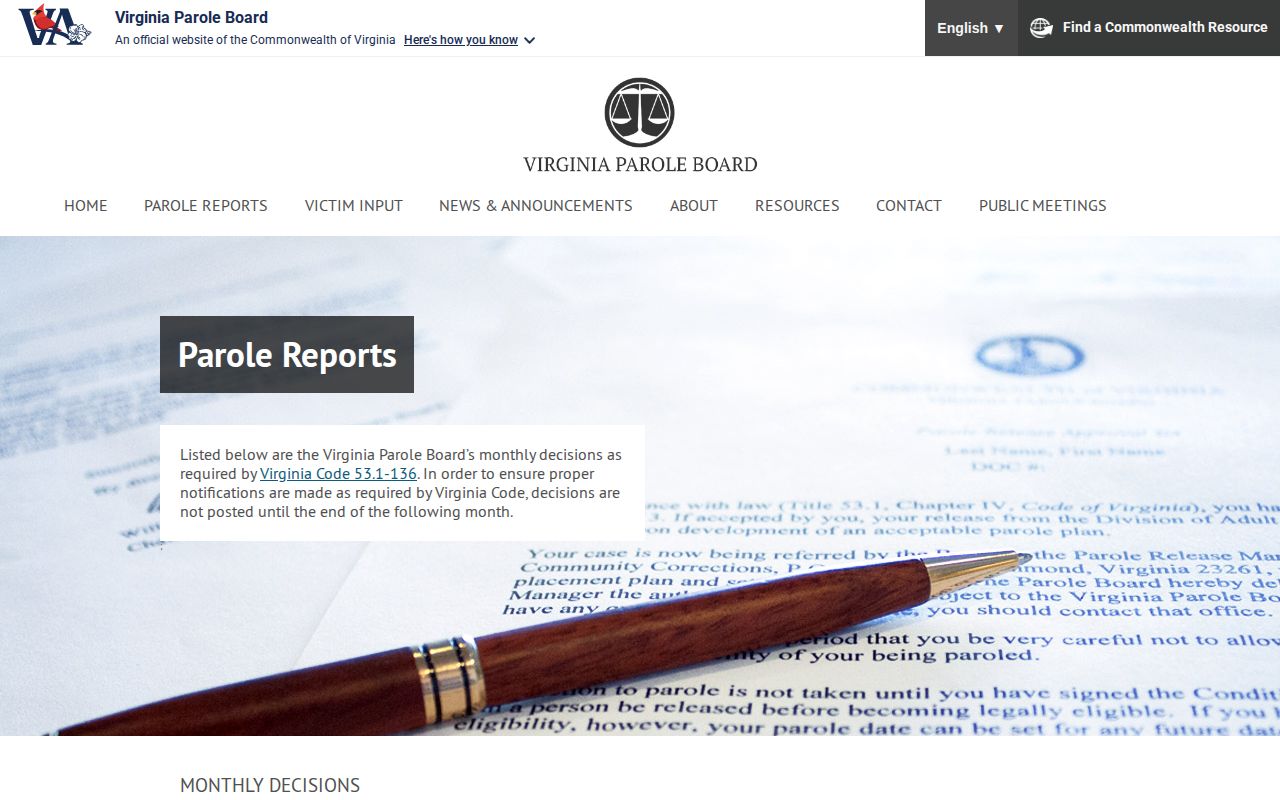
Use the report month that fits the known review date, then match the result against VADOC status.
Spotsylvania Supervision Violations
The controlling conditions come from the court order, parole documents, and supervising agency record. A claimed violation does not end supervision by itself. It can lead to an agency report, a court or Board process, a capias or warrant, revocation, added conditions, or another lawful outcome. The final order or agency decision should be read before describing the result.
No official Spotsylvania or RRJ public parole-and-probation absconder list was found. A person should never be labeled an absconder because calls go unanswered, a locator result changes, or an address is unknown. Absconder status follows agency action, a violation report, a court or Board process, and sometimes a warrant. RRJ's VCIN and NCIC check before release is an internal law-enforcement detainer screen. It is not a public warrant search.
For a known Spotsylvania probation case, later violation or capias entries may appear in the proper court docket. General District Court handles misdemeanor matters and preliminary felony stages; Circuit Court handles indicted felonies and appeals. Check both when the stage is unclear. Then confirm the entry with the clerk or supervising agency. A violation filing is an allegation or process event, not automatic proof of revocation. Likewise, a Board parole decision report may show action without proving the later physical custody event.
Property After a Spotsylvania Release
Release from RRJ also creates a practical records trail. At a scheduled release, property staff return personal property. A transfer is different. Religious and legal papers travel with the person, while other property may be held for only 30 days. An authorized third party can collect held property from 8:00 a.m. to noon Monday through Saturday, or mailing may be arranged after postage is confirmed. Unclaimed property may be disposed.
That process can help distinguish a community release from a facility transfer, but property pickup alone does not prove legal status. Keep the release entry, court order, and supervision record as the core evidence. Contact RRJ Property for the current pickup process before traveling, especially when someone else will collect the items. Written authorization and identity checks may be required by the facility's current procedure.
Note: Property handling can reveal a transfer workflow, yet only the custody and supervision records establish the person's formal status.
Spotsylvania Supervision Discharge
Discharge ends supervision. It is separate from release from jail or prison, which can happen months or years earlier. Probation may end through the terms of the sentencing order or a later court order. Parole ends through the lawful VADOC and Board process. Local program completion is documented by the court or RRJ program that administered it. One label cannot stand in for all three paths.
If the VADOC locator stops returning a person, seek the discharge order or letter. The locator is a current operational tool, not a guaranteed permanent archive. A Spotsylvania court file may show the final probation event, a violation outcome, or an order that ends supervision. Sealing and expungement can restrict access, so absence still is not proof. The durable answer is a record from the office that held legal authority.