
Spotsylvania Scheduled and Actual Release
A projected, anticipated, or estimated release date looks forward. It applies current sentence data and available credits to a future point, but it is not proof that the person left custody. Actual release is the completed event after staff review the file, resolve other legal holds, sign the required papers, and make the custody handoff. RRJ uses “estimated release date” for the VADOC Legal Update Sheet. VADOC victim notices use “anticipated release date.” Both terms signal that the date may move.
Pretrial detention works differently. Before a final sentence, release may depend on bond, a new court order, dismissal, a plea, or a trial outcome. There is no sentence-completion date to compute. A bond order creates authority to release, yet RRJ still completes processing and screens for detainers. For a sentenced person, the active order, concurrent or consecutive terms, mandatory minimums, presentence confinement credit, and the correct credit system become the starting inputs.
A departure from RRJ can also be a transfer to VADOC, another jail, or another authority. That is why a missing current-roster result cannot replace the release record. The full Spotsylvania County released-inmate lookup separates community release from transfer and continued custody.
Find a Spotsylvania Release Date
Begin with the final sentencing court. Spotsylvania General District Court handles misdemeanor cases and early felony proceedings. Circuit Court handles indicted felonies and appeals. Read the active sentence, suspended portion, credit language, consecutive or concurrent structure, and any later amended order. A court order establishes the legal term. It normally does not show the moment RRJ completes release or whether another hold takes effect.
For a state-responsible sentence, use the VADOC Inmate and Supervisee Locator. Search by seven-digit DOC ID when possible, or use at least the first three letters of the first name and the full last name. Start with few filters. Then compare name, age, identity details, location or status, and the date field displayed on the live result. VADOC warns that the locator updates daily and can be inaccurate or outdated, so save the date and time checked.
- Identify the court, case number, final sentencing date, and whether the person is pretrial or sentenced.
- Read the final order for active time, suspended time, mandatory minimums, and concurrent or consecutive terms.
- For a local sentence totaling no more than 12 months, ask RRJ Records for the existing computation record.
- For a state-responsible sentence, search VADOC and match the seven-digit DOC ID and all available identifiers.
- Ask for the Legal Update Sheet or specific VADOC computation record when a stable document is needed.
- Near the date, verify actual custody through RRJ, VADOC, the court, and any known receiving authority.
The official locator shows the public entry point used for state custody and supervision. Review the VADOC locator source with the captured search interface.
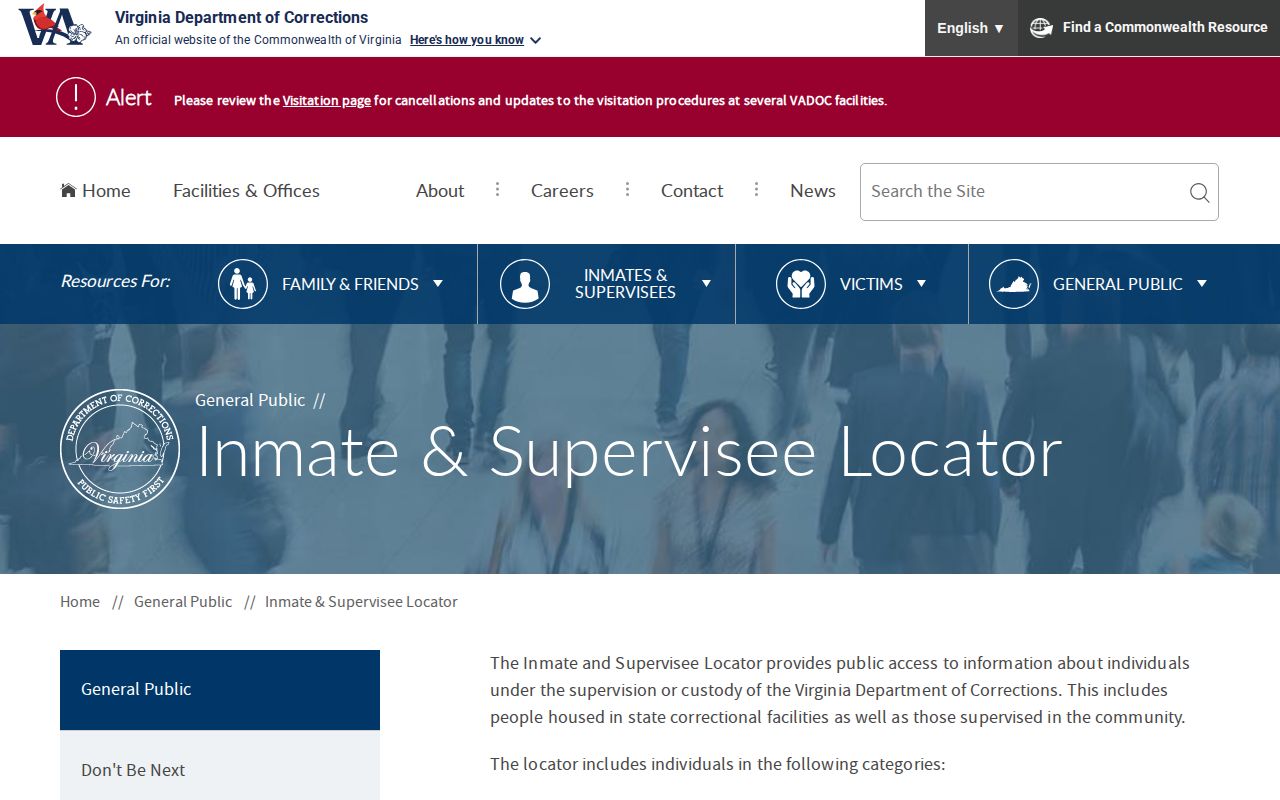
A live result must be read as it appears. No field should be invented from the static landing page, and no future date should be reported as an actual discharge.
Spotsylvania Legal Update Sheet
RRJ says a state-sentenced person should receive a VADOC Legal Update Sheet after final sentencing on all charges. The sheet includes a state number and an estimated release date. RRJ and the person both receive a copy. The stated normal interval is 90 to 120 days after all charges reach final sentencing, which means an immediate answer may not yet exist when several cases remain open or the state computation has not arrived.
This local handoff is the distinctive answer to many Spotsylvania release-date questions. Ask first whether every charge has a final sentence. Then ask whether the combined term is local or state responsible. If it is state responsible and the normal processing interval has passed, identify the person by full name and DOC ID and request the existing Legal Update Sheet or computation record from the proper custodian. Do not ask staff to make a new forecast.
The RRJ Bonds, Release, Sentencing page explains this division and the Legal Update Sheet timing.
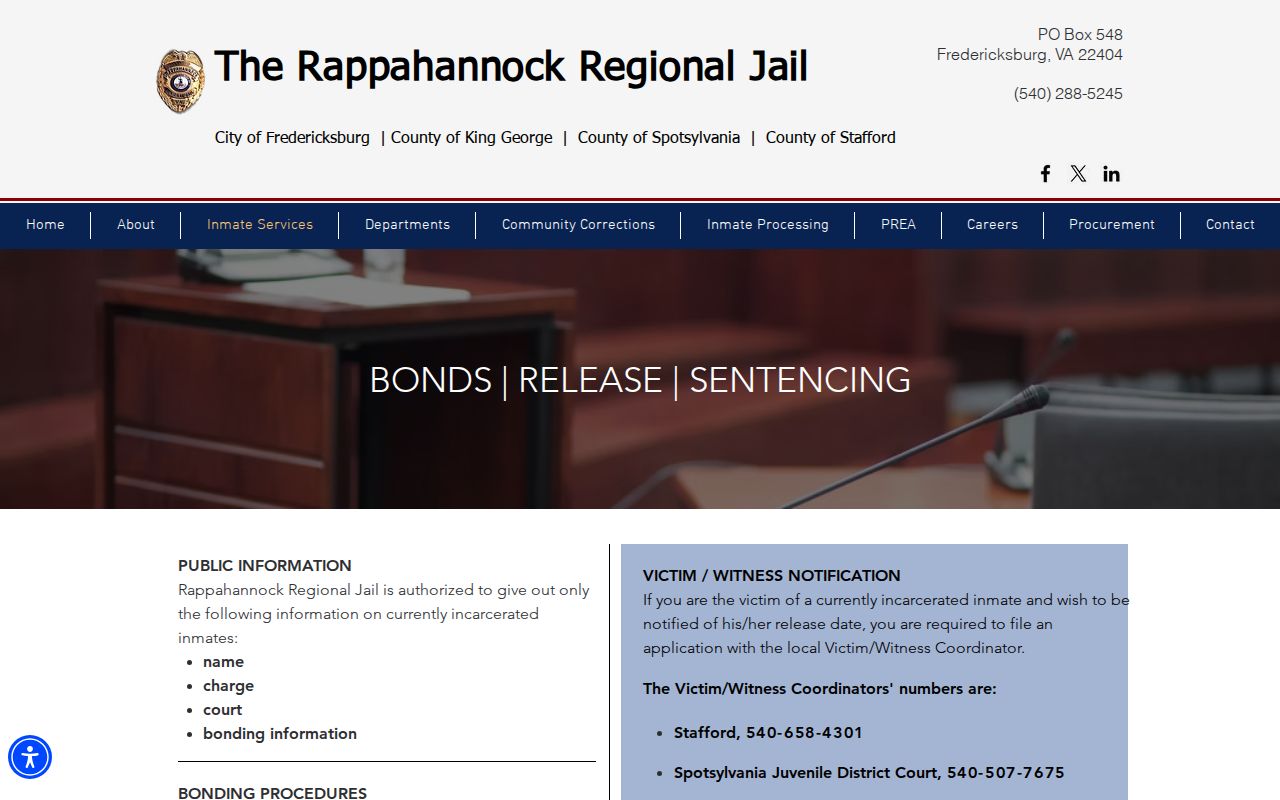
The same source separates the estimate from RRJ's fixed operational rule for a completed local time-served sentence.
Virginia Credits for Spotsylvania Release
Virginia has more than one credit regime. For a misdemeanor sentence or combined local term totaling no more than 12 months, and absent a mandatory minimum, § 53.1-116 provides one day of good-conduct credit for each day served without a rule violation, including qualifying presentence jail days. This supports RRJ's shorthand that many local misdemeanor calculations are about one-half of the imposed time. It is not a promise. Mandatory time, lost credit, and the structure of the court order can change the result.
Older parole-eligible Good Conduct Allowance sentences use a different state framework. VADOC explains that principally pre-1995 felonies and older misdemeanors may earn from zero to 30 days per 30 served based on class. VADOC calculates parole eligibility, mandatory parole release, and good-time release for active or combined GCA sentences over 12 months. The applicable offense date is essential.
For felonies committed on or after January 1, 1995, Virginia Code § 53.1-202.2 defines eligibility and § 53.1-202.3 sets rates. Enumerated subsection A offenses can earn no more than 4.5 days for each 30 served. Other eligible subsection B offenses use four levels: 15, 7.5, 3.5, or zero days per 30. Conduct, participation, exclusions, classification, and the law in force for the offense matter.
The familiar claim that every Virginia felony requires 85 or 87 percent is false. The maximum 4.5-credit rate roughly yields the 85-percent shorthand for covered offenses, while other eligible offenses may earn more. RRJ uses approximately 87 percent in its local explanation of post-1995 “A” felonies. That is operational shorthand, not the universal statutory formula. The VADOC Time Computation page presents the governing systems.
The credit category must be identified before any rate is applied, and a public calculator cannot replace the agency's computation.
Note: Virginia Code §§ 53.1-202.2 and 53.1-202.3 make offense eligibility and credit level essential to any projected result.
Why Spotsylvania Release Dates Change
A projected release date is recalculated when an input changes. The most common causes are not clerical delay alone. Credits can be earned, lost for a rule violation, or restored under lawful authority. A court may correct a sentence or jail-credit total. Another case may add consecutive time. Records staff may discover an uncalculated sentence, warrant, detainer, or continued-custody order before discharge.
| Change | Effect on the date | Where to verify |
|---|---|---|
| Credit level or participation | Changes the rate earned over time | VADOC computation record |
| Discipline and forfeiture | Can move the estimate later | VADOC or RRJ record |
| Corrected jail credit | Can move the date earlier or later | Court order and computation |
| Amended or vacated sentence | Changes the legal term | Final court order |
| Concurrent or consecutive case | Changes how terms combine | Court and records unit |
| Warrant, detainer, or hold | May prevent community release | Releasing and receiving authority |
| Parole action | May create, defer, or rescind a release path | Virginia Parole Board and VADOC |
Virginia Code § 53.1-189 allows credit forfeiture for institutional rule violations and places restoration with the Director. Before a VADOC release, staff also check warrants, detainers, continued-custody orders, disciplinary matters, and uncalculated sentences. These checks explain why even a well-supported estimate should be labeled with its source date.
Spotsylvania Release-Day Rules
RRJ publishes a precise rule for local time-served releases: the person is released at 8:00 a.m. on the sentence-completion date. Its policy also says satisfaction-date release applies across weekends and holidays. This rule is useful only after RRJ confirms that the sentence is local, complete, and free of another hold. Bond releases operate seven days a week, but no fixed completion time is promised because paperwork and detainer checks still must finish.
VADOC uses a different state-facility rule. Its release procedure says discharge or parole release occurs by 11:59 p.m. on the release date, weather permitting. Beforehand, staff complete final record checks and release documents. Neither clock promises release to the community when another agency takes custody. A transfer, detainer pickup, or continued-custody order can end one agency's hold while another begins.
The official VADOC Facility Release page describes state release preparation and timing.
The state procedure belongs to VADOC custody, while RRJ's 8:00 a.m. rule belongs to eligible local time-served releases.
Confirm a Spotsylvania Release Date
Near the estimated date, return to the system that holds the person. For RRJ custody, Virginia Jail VINE may give an individual custody-change alert, while the jail release entry supplies durable proof. For VADOC custody, the locator and VADOC records establish state status. The VINELink Check explains the separate jail notification route. VADOC no longer uses VINELink for state-prison notifications, so eligible victims must use NAAVI and Victim Services instead.
Actual release should be confirmed with the date, releasing authority, release type or destination, and any continuing supervision. Keep transfers distinct from release to the community. A parole grant is not discharge. A court order is not the jail's completion timestamp. When certainty matters, obtain the signed release entry, Order of Release, discharge record, or other existing document from the agency that completed the event.